inquiry
65337e7cc4b2e10867

Leave Your Message

0%

Picking out a carbon fiber panelin 2026 really starts with a simple, yet crucial question: what do you actually need the panel to do? Because, honestly, a lightweight decorative cover has totally different requirements compared to a structural part that's got to handle vibrations, heat, or repeated stress. Sure, appearance is important—no one wants a dull-looking piece—but it’s not the whole story. A shiny finish can hide a lot, like how the fibers are oriented, the core construction, or the quality of the resin.

So, it’s a good idea to look at what you’re planning to use the panel for—check the size, thickness, and any published performance specs. And don’t just assume those specs are for the finished product; sometimes they only refer to raw materials. That little difference can make a big impact. Make sure the fiber directions and layup match the stresses your design will face, and double-check that mounting holes, edges, and fasteners won’t create weak spots. If you're working on something critical or demanding, it’s smart to get advice from an engineer and ask for test data you can trace. Even a sample panel is useful—it can tell you about the surface feel, color variations, and how it machines—but keep in mind, testing is still the gold standard.

And let’s be real: things like weight, stiffness, finish, temperature tolerance, and budget don’t always line up perfectly. A slimmer panel might save weight but could flex more—yeah, it’s true sometimes! Make sure to verify that it plays nice with the adhesives, coatings, and other materials you’re using before you go all in. If a supplier isn’t clear with their specs, that’s a red flag—don’t just accept it, ask more questions. Choosing the right panel is all about balancing these trade-offs. Even the most careful buyers can miss a detail now and then. This guide is here to help you compare construction styles, validate claims, and pick a panel that actually suits the real conditions it’ll face—that way you’re not left surprised down the line.
How to Choose Carbon Fiber Panels in 2026?

Define Your Carbon Fiber Panel Application and Performance Goals

How to Choose Carbon Fiber Panels in 2026?

Define the panel’s real job before comparing specifications. A Carbon Fiber Panel Sheet for a drone arm needs low mass and controlled vibration. An equipment cover may need impact resistance, fire performance, and stable mounting points. In workshop testing, I have seen lightweight panels crack around over-tightened fasteners. The failure was not a material defect. The application was poorly defined.

Set measurable goals for stiffness, strength, thickness, temperature, and surface quality. The U.S. Department of Energy reports that reducing vehicle weight by 10% can improve fuel economy by roughly 6–8%. That benefit matters only when the panel replaces heavier material without creating new support hardware. MarketsandMarkets has also projected strong carbon fiber market growth, with an estimated compound annual growth rate near 8.7% between 2023 and 2028. Growth can widen supplier choices, but published data still needs verification. A high modulus value alone does not guarantee better field performance.

Tips: Write a short load case. Include span length, fastener spacing, expected impact, and operating temperature. Request fiber orientation, resin type, laminate thickness, and test standards. Check the panel under real clamps, not only in a catalog table. If weight is the only target, reconsider it. Thin panels may flex, buzz, or fail at edges. My own preference is conservative sizing, though it is not always the cheapest choice.

Compare Carbon Fiber Panel Types, Weaves, and Construction Methods

Choosing Carbon Fiber Panels in 2026 requires more than checking a glossy surface.

Panel type, weave pattern, and construction method affect stiffness, weight, appearance, and durability. Start with the panel’s purpose. A flat interior cover may need only a thin laminate. A structural enclosure needs verified load data and controlled manufacturing.

Prepreg panels use pre-impregnated fibers and usually offer consistent resin content. They can be light and precise, but require careful curing.

Wet layup panels are more flexible for small production runs. However, excess resin can add weight and create weak areas.

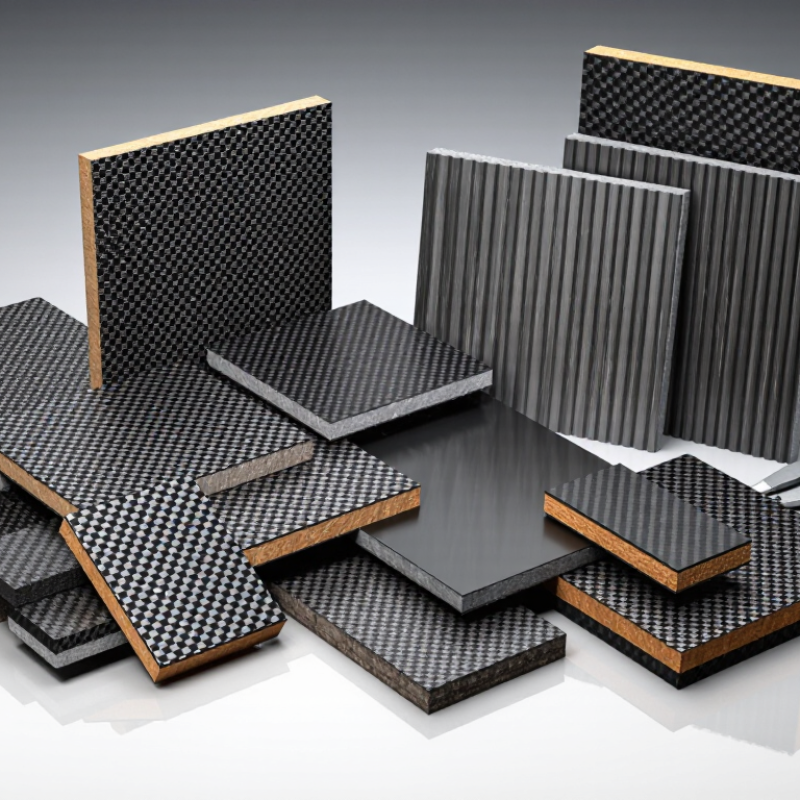
Compression-molded panels often provide repeatable thickness and clean edges. Sandwich panels add a foam or honeycomb core between carbon skins. They can resist bending well without becoming excessively heavy. Check the core material and edge sealing, not just the carbon surface.

Weave choice changes both performance and appearance.

Plain weave looks orderly and handles shaping well. Twill weave drapes around curves more easily and creates a distinctive diagonal pattern. Unidirectional carbon places fibers along one main load path, making it efficient for beams or narrow supports. Hybrid layups may balance strength in several directions.

My first panel selection focused too heavily on appearance. That was a mistake. Inspect fiber alignment, resin-rich corners, voids, thickness variation, and mounting holes.

Request test information when available, then compare it with the actual operating temperature, vibration, and impact risk. A panel that looks perfect can still be poorly engineered.

Evaluate Strength, Stiffness, Weight, and Durability Requirements

How to Choose Carbon Fiber Panels in 2026?

Selecting a panel starts with the load, not its appearance. A Racing Car Carbon Fiber Panel may face braking vibration, cornering forces, stones, heat, and repeated impacts. Composite Materials Handbook-17 reports typical carbon-fiber tensile strengths near 3.5–7 GPa, while elastic modulus can range from about 230–600 GPa. These figures vary with fiber grade, resin, layup, and testing direction. Strength resists breaking. Stiffness limits bending. They are not interchangeable.

Weight also needs context. The U.S. Department of Energy’s Vehicle Technologies Office estimates that a 10% vehicle weight reduction can improve fuel economy by roughly 6–8%. However, removing material can reduce impact tolerance. Check areal weight, laminate thickness, core construction, fastener zones, and edge protection. For durability, request fatigue, moisture, ultraviolet, temperature, and impact results. ASTM D3039, D790, and D7136 are useful reference methods. A glossy surface proves little.

Tips: Compare test results from the same panel size and layup. Inspect drilled holes for white stress marks, crushed edges, and uneven resin. Ask whether the panel was tested after environmental conditioning. I often use a small load test and detailed photographs before installation. This process is not perfect. Hidden delamination can escape a visual inspection, especially around mounting points. Leave a safety margin for real road abuse, not only laboratory numbers.

Choose the Right Panel Thickness, Size, and Surface Finish

Choosing a carbon fiber panel in 2026 starts with the job, not the appearance. Thickness controls stiffness, weight, edge strength, and drilling behavior. A 1 mm panel may suit a cover, while a 3 mm panel can better resist bending. Those figures are not universal. Measure the unsupported span, expected load, and fixing points before ordering. For an OEM Carbon Fiber Panel, request the laminate schedule, thickness tolerance, and test method. A caliper check at several points can reveal uneven compression or finishing buildup.

Size deserves equal attention. Choose a sheet slightly larger than the finished part when trimming is unavoidable. Allow room for clean edges, holes, and corner radii. Large panels reduce joints, but they may flex during transport and machining.

I prefer checking the cutting plan on paper first. It prevents a small hole from wasting an expensive sheet. Still, my first layout is sometimes wrong. Material grain and fiber direction can change the practical result.

Surface finish should match handling and inspection needs. A gloss surface shows depth clearly, but fingerprints and fine scratches appear quickly. A matte finish hides minor marks and can reduce glare near instruments. Textured finishes offer grip, yet they may complicate cleaning and visual inspection. Ask how the surface was cured and whether protective film is included. Before installation, inspect under angled light for pinholes, waviness, or resin-rich patches. If the panel feels perfect, test it anyway. Small sample tests often expose assumptions that a specification sheet cannot.

Check Resin Systems, Temperature Resistance, and Environmental Protection

When choosing a Custom Carbon Fiber Panel in 2026, start with the resin system, not the glossy weave. Epoxy usually provides strong adhesion and low shrinkage. Vinyl ester can offer better chemical resistance and lower cost. For elevated service temperatures, check the resin’s glass-transition temperature, or Tg. A panel rated near its Tg may soften under repeated heat cycles. The U.S. Department of Energy’s Vehicle Technologies Office estimates that a 10% vehicle weight reduction can improve fuel economy by roughly 6–8%. That benefit disappears if the laminate loses stiffness.

Temperature claims require careful testing. Ask for data from ASTM D3418, thermal cycling, and moisture conditioning. Check the actual service range. Not just the peak number. A dashboard panel exposed to sunlight may exceed 80°C, while an engine-bay part faces sharper thermal swings. I would not approve a panel from a datasheet alone. Small edge cracks can reveal poor consolidation, even when the surface looks perfect.

Environmental protection includes UV stability, water sealing, salt exposure, and galvanic isolation around metal fasteners. The International Energy Agency’s Global EV Outlook 2024 reports more than 14 million electric cars were sold globally in 2023. More vehicles now need durable lightweight structures across varied climates. Specify a UV-resistant clear layer, sealed edges, and documented salt-spray results. Carbon fibers resist corrosion, but resin systems, inserts, and adhesive joints remain vulnerable. That detail is easy to overlook.

How to Choose Carbon Fiber Panels in 2026

Compare indicative continuous-use temperature ranges by resin system. Actual limits depend on the specific formulation, cure, load, and exposure conditions.

Selection note: Check the panel datasheet for glass-transition temperature (Tg) and the manufacturer's recommended service limit; Tg is not itself a service-temperature rating. For outdoor or wet environments, look for UV-resistant coatings, sealed edges, and verified moisture and chemical resistance.

Verify Quality Standards, Supplier Reliability, and Total Cost

How to Choose Carbon Fiber Panels in 2026?

A reliable purchase starts with documented specifications, not a glossy surface. Check panel thickness, fiber direction, resin type, and stated tolerances against your design needs. Ask for current test reports and batch traceability; a certificate without matching product details tells you little. Inspect a sample under good light for uneven weave, resin-rich patches, or edge voids. These signs do not prove failure, but they deserve questions.

Supplier reliability shows up in the details. Confirm typical lead times, packaging methods, and how the supplier handles out-of-spec panels. Request a sample from the same production process planned for your order. Compare it with the datasheet, and keep measurements. A missed tolerance can mean extra machining or rejected parts. I would not choose on price alone; still, supplier claims should be checked rather than simply trusted.

Tips: Calculate total cost per usable panel, including shipping, inspection, cutting, finishing, and expected scrap. Get key specifications and delivery dates in writing. Small orders can reveal inconsistencies, though they may not predict every production batch. Leave room for a second review.

How to Choose Carbon Fiber Panels in 2026? — Verify Quality Standards, Supplier Reliability, and Total Cost
Evaluation Area What to Specify or Compare Evidence to Request Why It Matters
Panel construction Confirm whether the panel is a solid laminate or a sandwich panel, and identify the reinforcement, resin system, core (if applicable), and surface finish. Datasheet, laminate or panel specification, and a cross-section or sample where appropriate. Construction affects stiffness, strength, weight, impact behavior, machining, and suitability for the application.
Fiber orientation and laminate design Request the ply orientations, stacking sequence, nominal thickness, and any stated design directions. Compare properties in the directions relevant to the part. Layup schedule or controlled product specification, plus test data with specimen orientation identified. Composite properties are directional; a value measured in one direction may not describe performance in another.
Mechanical test methods For tensile properties, check whether testing used ASTM D3039/D3039M or an applicable ISO 527 method. For flexural properties, check ASTM D7264/D7264M or ISO 14125. Test reports showing the method and edition, specimen details, conditioning, direction, results, and deviations from the method. Recognized methods help make results more comparable. The test method and specimen configuration must still suit the panel and intended use.
Constituent content Where relevant, compare fiber and resin content and the measurement basis. ASTM D3171 is a test method for constituent content of composite materials. Test report identifying the method, sample, units, and whether results are by mass or volume. Constituent content can help characterize a laminate, but it does not by itself establish structural performance or panel quality.
Quality system and lab competence Check the supplier’s quality-management documentation. ISO 9001 concerns quality-management systems; it is not a product-performance certification. Current scope and validity details for any claimed certification. For external testing, check whether the laboratory is accredited to ISO/IEC 17025 for the relevant tests. System and laboratory credentials help assess process controls and test competence; they do not replace product-specific evidence.
Batch consistency and traceability Ask how panels or production batches are identified, inspected, and linked to their material and process records. Sample certificate of conformity, batch identification, inspection records, and a documented process for handling nonconforming material. Traceability supports investigation and verification if a delivered batch does not meet the agreed specification.
Dimensions and tolerances Define required length, width, thickness, flatness, edge condition, and any machining tolerances in the purchase specification. Dimensioned drawing, stated tolerance limits, and inspection results for the supplied order. Clear limits reduce fit-up problems, rework, and disputes over whether a panel is acceptable.
Environmental and service conditions State the intended temperature range, moisture or chemical exposure, UV exposure, fire requirements, and service loads where applicable. Relevant test data or a written statement of limitations for the specified resin, finish, and panel construction. Performance depends on the material system and environment. Do not assume results from one condition apply to another.
Supplier reliability Assess documented production capability, lead-time commitments, communication, change control, and continuity of supply. Written quotation and delivery schedule, production and inspection plan, change-notification terms, and references or performance records where available. A technically suitable panel can still create project risk if delivery, specification control, or corrective-action processes are unreliable.
Acceptance criteria Set project-specific limits for properties, dimensions, appearance, defects, and required documentation before ordering. Approved specification or drawing that identifies test methods, sampling rules, acceptance limits, and required records. There is no single universal acceptance threshold for every carbon fiber panel; limits should follow the design and application requirements.
Total cost of ownership Compare the quoted panel price together with cutting, machining, finishing, inspection, packaging, freight, duties, expected scrap, and any tooling or setup charges. Itemized quotations using the same dimensions, tolerances, quantity, delivery terms, and required documentation. The lowest unit price may not be the lowest delivered or usable cost when processing, waste, logistics, or inspection differ.
Final supplier comparison Use a common specification and compare technical compliance, evidence quality, delivery risk, and itemized total cost side by side. Completed comparison record showing deviations, open questions, quote validity, and the basis for the selection. A consistent comparison makes trade-offs visible and helps ensure the selected panel meets the project’s documented needs.

Plan Installation, Maintenance, and Long-Term Replacement Needs

For carbon fiber panels, plan the job before choosing a finish. Record panel dimensions, support spacing, expected loads, heat exposure, and access for future inspection. Confirm the panel’s fiber direction and laminate schedule with the supplier; stiffness can vary across the sheet. One detail is easy to miss: carbon fiber can promote galvanic corrosion when it contacts some metals. Use compatible isolating layers, seal cut edges, and specify suitable washers and fasteners. Test one installed panel first. Small fit problems can become expensive across a full run.

Installation is only part of the cost. Set inspection intervals around actual use, then check edges, fastener holes, surface cracks, and areas exposed to impact or moisture. Keep installation records, photographs, and material specifications together. The U.S. Department of Energy’s vehicle-lightweighting assessment estimates that a 10% reduction in vehicle weight can improve fuel economy by about 6–8%; that figure is not a promise for every panel or application. It does show why weight targets should be balanced against durability and repair access. Plan replacement around removable fasteners where practical, and keep matching panel details on file. A spare panel may still differ in shade. That’s worth checking.

FAQS

What should I define before choosing a carbon fiber panel?

Define the panel’s real job, unsupported span, load, temperature, vibration, and impact risk. A cover needs different performance from a structural enclosure. Write a short load case.

How does panel thickness affect performance?

Thickness influences stiffness, weight, edge strength, and drilling behavior. A thin panel may suit a light cover. A thicker panel usually resists bending better. These are only starting points.

Which carbon fiber construction method should I consider?

Prepreg panels offer controlled resin content and precise laminates. Wet layup suits smaller production runs but may contain excess resin. Compression molding can provide consistent thickness and clean edges. Choose carefully.

When are sandwich panels useful?

Sandwich panels place a foam or honeycomb core between carbon skins. They can resist bending without adding excessive weight. Check the core, edge sealing, and mounting areas. The surface alone proves little.

How do weave patterns change panel performance?

Plain weave handles shaping well and creates an orderly appearance. Twill weave follows curves more easily. Unidirectional fibers suit beams and narrow supports. Hybrid layups can spread strength across several directions.

What defects should I inspect before installation?

Check fiber alignment, voids, resin-rich corners, waviness, pinholes, and thickness variation. Inspect mounting holes closely. Use angled light. A glossy surface can hide engineering problems.

How should I select panel size and cutting allowance?

Choose a sheet slightly larger than the finished part when trimming is required. Allow space for holes, clean edges, and corner radii. Review the cutting plan before machining. I have wasted material through poor layouts.

Which surface finish is best for a carbon fiber panel?

Gloss finishes show fiber depth but reveal fingerprints and fine scratches. Matte finishes reduce glare and hide minor marks. Textured surfaces improve grip but may complicate cleaning. Match the finish to daily handling.

What information should I request from a supplier?

Request fiber orientation, resin type, laminate schedule, thickness tolerance, and test methods. Ask about temperature, vibration, impact, and surface curing. Compare the data with real clamps and fasteners. Catalog numbers are not enough.

How can I verify a panel before final installation?

Test a small sample under realistic clamps, fastener spacing, and expected loads. Measure thickness at several points with calipers. Check flexing, edge behavior, and surface damage. My first assumption is sometimes wrong.

Conclusion

Choosing a Carbon Fiber Panel in 2026 starts with defining its intended application and the performance goals it must meet. Compare panel types, weave patterns, and construction methods, then assess strength, stiffness, weight, and durability against the conditions the panel will face. Select a suitable thickness and size, and consider whether the surface finish fits both functional needs and appearance preferences.

Before purchasing, check the resin system, temperature tolerance, and protection against moisture, UV exposure, and other environmental factors. Review available quality information, assess supplier reliability, and compare total cost rather than upfront price alone. Finally, plan how the panel will be installed, inspected, and maintained, and consider how easy it will be to replace over time. A careful evaluation of these factors can help you choose a panel that balances performance, service life, and practical requirements.

Olivia

Olivia

Olivia is a dedicated marketing professional at Shenzhen Feimoshi Technology Co., Ltd., specifically within Project Three. With a deep understanding of the company’s innovative products and services, she plays a pivotal role in shaping the brand’s online presence. Olivia is passionate about sharing......
Previous Why Choose a Carbon Fiber Gift for Business Buyers?